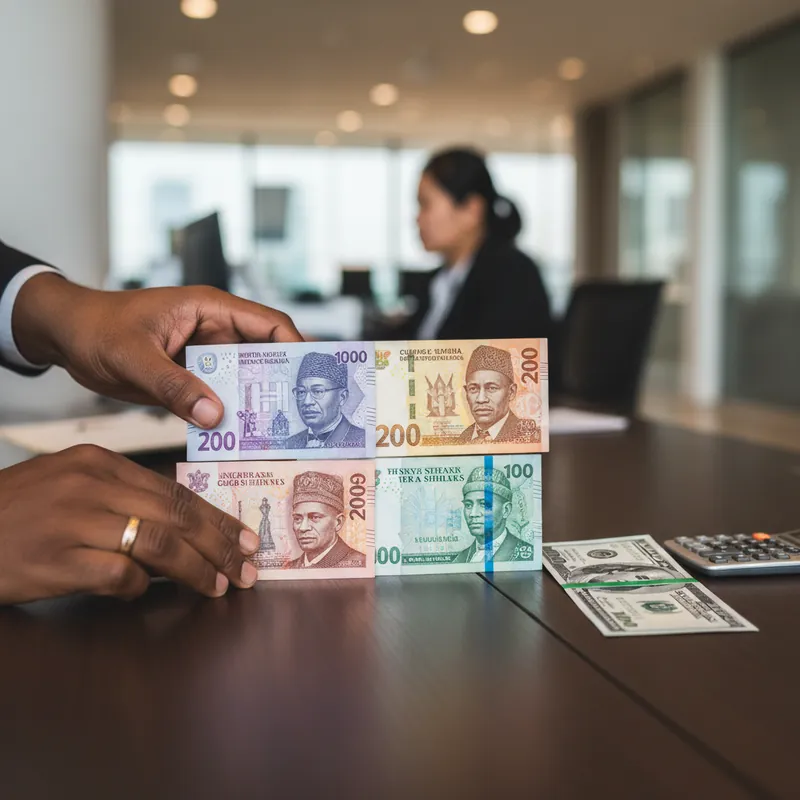
USD ↔ ZAR / NGN / KES / GHS / UGX / TZS Multi-Currency Reference 2026
For African travellers planning international trips in 2026, currency planning matters as much as fare planning. Conversion margins of 3-7% are normal across the four major African source currencies — South African Rand (ZAR), Nigerian Naira (NGN), Kenyan Shilling (KES) and Ghanaian Cedi (GHS) — plus the smaller East African markets of Uganda (UGX) and Tanzania (TZS). This reference lays out May 2026 indicative rates, conversion channels per country (banks, bureaux de change, Wise, Revolut, MoneyGram, Western Union), the Nigerian dual-rate context, and the declaration thresholds that catch out travellers at departure.
TL;DR: May 2026 indicative rates: 1 USD = 18.50 ZAR, 1,550 NGN (official CBN) / 1,650 NGN (parallel market BDC), 130 KES, 14.50 GHS, 3,750 UGX, 2,600 TZS. Cross-rates: 1 GBP = 1.28 USD, 1 EUR = 1.10 USD. Best 2026 conversion channels by market: SA → FNB/Standard Bank online forex (no commission above ZAR 50k); NG → licensed BDC (parallel rate, ABCON-regulated); KE → CBK-licensed Forex Bureau (Westlands cluster); GH → BoG-licensed Forex Bureau. Wise supports inbound to all six currencies; Revolut works for ATM use across Africa but no native accounts. Cash declaration thresholds at departure: SA ZAR 25,000 / NG USD 10,000 / KE KES 1,000,000 / GH USD 10,000.
In this tool
- May 2026 indicative cross-rates
- Conversion options per country: SA, NG, KE, GH, UG, TZ
- Nigerian Naira dual-rate explained
- Cross-border money platforms: Wise, Revolut, Western Union, MoneyGram
- Cash declaration thresholds when leaving Africa
- ATM use abroad: fees, DCC pitfalls, network strategy
- Frequently asked questions
May 2026 indicative cross-rates {#rates}
The table below shows mid-market reference rates as published by the respective central banks and aggregated wholesale interbank feeds in early May 2026. Retail rates at banks, bureaux and online platforms will sit 1-5% wider depending on channel.
| Pair | Mid-market | Common retail buy | Common retail sell |
|---|---|---|---|
| USD/ZAR | 18.50 | 18.95 | 18.10 |
| USD/NGN (official CBN) | 1,550 | 1,565 | 1,535 |
| USD/NGN (parallel BDC) | 1,650 | 1,680 | 1,625 |
| USD/KES | 130 | 132 | 128 |
| USD/GHS | 14.50 | 14.85 | 14.25 |
| USD/UGX | 3,750 | 3,820 | 3,700 |
| USD/TZS | 2,600 | 2,650 | 2,560 |
| GBP/USD | 1.28 | 1.275 | 1.285 |
| EUR/USD | 1.10 | 1.095 | 1.105 |
| USD/AED (UAE Dirham) | 3.67 | 3.69 | 3.65 |
| USD/SAR (Saudi Riyal) | 3.75 | 3.77 | 3.73 |
Useful African cross-rates for intra-Africa travel
| Pair | Mid-market |
|---|---|
| ZAR/NGN | 83.78 |
| ZAR/KES | 7.03 |
| ZAR/GHS | 0.78 |
| NGN/KES | 0.084 (or KES 1 = NGN 11.92) |
| GHS/NGN | 106.90 |
These intra-African rates apply mainly for traders, intra-African business travellers and Pan-African remittance senders. For tourism budgeting, the USD or EUR pair is more commonly the reference.
Reading rate context
The 2025-2026 macro context for the four main African currencies is roughly:
| Currency | 2025-2026 trend driver |
|---|---|
| ZAR | Stable around 18-19/USD, supported by commodity exports and balanced current account |
| NGN | Recovered from 2024 lows after CBN unified the rate; dual-rate gap narrowing |
| KES | Strengthened in 2024-25 on improved foreign-exchange reserves; relatively stable |
| GHS | Recovering from the 2022-23 sovereign-debt restructuring crisis; gradual stabilisation |
| UGX | Stable, gradual mild depreciation pattern |
| TZS | Stable; controlled managed float by Bank of Tanzania |
Conversion options per country: SA, NG, KE, GH, UG, TZ {#per-country}
South Africa (ZAR) — the four-bank system
South African residents converting ZAR for international travel work mostly through the four main retail banks: First National Bank (FNB), Standard Bank, Absa and Nedbank. All four operate online forex platforms where the spread is typically narrower than at airport bureaux (where margins of 6-10% are common).
| Channel | Typical USD/ZAR margin | Notes |
|---|---|---|
| FNB online forex | 1.5-2.5% | Best rate over ZAR 50,000; cash collection at branch |
| Standard Bank online forex | 1.5-2.5% | Includes Mauritius / SADC forex specialisation |
| Absa online forex | 2.0-3.0% | Strong Cash Passport multi-currency card product |
| Nedbank online forex | 2.0-3.0% | Travel-card option, MultiTravel card |
| Bidvest / Travelex airport bureau | 6-10% | Convenience only; avoid for amounts >USD 200 |
| FNB Global Account (USD holding) | Spot conversion | Useful for frequent travellers; SARB exchange-control compliant |
SA residents are subject to SARS-monitored exchange controls: the Single Discretionary Allowance is ZAR 1,000,000 per calendar year for general purposes and the Foreign Investment Allowance is ZAR 10,000,000 per year with a Tax Clearance Certificate. Standard travel use falls well within these limits.
Nigeria (NGN) — official + parallel BDC
Nigeria operates a dual-rate currency market that became formalised in 2023 when the Central Bank of Nigeria (CBN) unified previously-segregated official windows and let the rate float. Two legal market segments exist:
| Market segment | Operator | Typical rate (May 2026) | Use case |
|---|---|---|---|
| Official CBN window | Commercial banks (GTBank, Zenith, UBA, Access, First Bank) | 1,550 NGN/USD | Letters of credit, corporate forex, formal trade |
| Parallel market (BDC) | ABCON-licensed Bureau de Change operators | 1,650 NGN/USD | Retail travel forex, personal remittance recipient |
Both markets are legal. The Association of Bureau De Change Operators of Nigeria (ABCON) regulates the BDC network, and licensed BDCs operate under CBN authorisation. For inbound travellers receiving USD, EUR or GBP in Nigeria, the BDC parallel rate delivers more NGN per dollar than the bank window. For outbound travellers buying USD, the bank window (when available) is the cheaper source. The CBN periodically publishes the official rate; the parallel rate is reported by aggregators such as AbokiFX and licensed BDC publication.
Kenya (KES) — CBK-licensed forex bureaus
Kenya’s retail forex market is one of the more efficient in Africa. Westlands and Karen in Nairobi host clusters of Central Bank of Kenya (CBK)-licensed forex bureaus, with typical USD/KES retail margins of 1-2%. Major banks (Equity Bank, KCB, NCBA, Co-op Bank, Stanbic) operate online forex and travel-card products competitive with the bureau market.
Ghana (GHS) — BoG-licensed forex bureaus + recovering market
Ghana’s forex market is regulated by the Bank of Ghana (BoG). Licensed forex bureaus cluster in Accra (Osu, Airport Residential) and Kumasi. Following the 2022-23 sovereign-debt restructuring and subsequent IMF programme, the cedi has stabilised but with retail USD/GHS spreads slightly wider than typical East African markets — typically 2.5-4%.
Uganda (UGX) and Tanzania (TZS) — bureau cluster markets
Both Uganda and Tanzania operate active retail forex bureau networks. In Kampala, the Kampala Road and Garden City clusters host the highest concentration of licensed bureaux; in Dar es Salaam and Arusha, hotel-district bureaux are the typical retail outlets. Margins on USD/UGX and USD/TZS are typically 1.5-3%, comparable to the Kenyan market.
Nigerian Naira dual-rate explained {#ngn-dual-rate}
The NGN dual-rate is the most commonly misunderstood African forex feature. Important factual points for travellers:
- Both markets are legal. ABCON Bureau de Change operators hold formal CBN licences. The parallel-rate term reflects market structure (retail BDC channel vs interbank official channel), not legality.
- The gap has narrowed since 2023. After the CBN unified the rate, the typical spread between official and parallel has compressed from 60-100% (2022) to 5-10% (May 2026).
- Who quotes which rate depends on context. Banks generally quote the official rate to corporate customers and the parallel-band rate to retail walk-in customers; BDCs always quote near the parallel rate.
- Use case matters. Travellers receiving USD as remittance into NGN benefit from the parallel rate; travellers buying USD with NGN benefit when banks are selling at near-official.
- Both markets accept standard documentation. Passport, valid travel ticket and supporting documentation are required for transactions above NGN 5,000,000 equivalent at both bank and BDC counters.
This is a factual market structure description with no political dimension; it is simply how the Nigerian retail forex market is organised in 2026.
Cross-border money platforms: Wise, Revolut, Western Union, MoneyGram {#platforms}
Wise (formerly TransferWise)
Wise is the most widely-used digital forex platform for African corridors in 2026. Coverage matrix:
| Corridor | Outbound from Wise | Inbound to Wise |
|---|---|---|
| USD → ZAR | Yes, fast settlement | Yes, via Wise USD/EUR/GBP balance |
| USD → NGN | Yes, fast settlement | No (Wise cannot maintain NGN balance for NG residents) |
| USD → KES | Yes, fast settlement | No native KES balance |
| USD → GHS | Yes, fast settlement | No native GHS balance |
| USD → UGX | Yes | No |
| USD → TZS | Yes | No |
Wise typical margin: 0.4-0.8% above mid-market, plus a small flat fee. For sending USD/EUR/GBP from a foreign account to a recipient in any of the six African currencies, Wise is consistently among the cheapest channels.
Revolut
Revolut supports multi-currency holding for users with EU, UK, US, Australian or Singaporean residency. African residents cannot open native Revolut accounts. Practical use case for African travellers: a Revolut card opened during a stay in the UK/EU can be used for ATM withdrawals across Africa with the standard fair-usage allowance (€1,000-3,000/month free of fees depending on plan), then 2% above. This is a niche but valuable structure for African diaspora users.
Western Union and MoneyGram
Both remain the primary cash-in / cash-out channels for unbanked or partially-banked African travellers, and for inbound remittance to recipient pickup. Typical margin and fee combined: 4-7% USD → ZAR/NGN/KES/GHS. Speed: minutes for cash pickup, hours for bank account credit. They remain dominant for the African remittance corridor despite the higher margin because of network depth (agent locations) in rural and peri-urban areas where Wise/Revolut do not deliver.
African digital wallets — M-Pesa, MTN MoMo
Two regional mobile-money networks dominate East and West African intra-country and select cross-border use:
| Platform | Primary geography | Cross-border feature |
|---|---|---|
| M-Pesa (Safaricom/Vodacom) | Kenya, Tanzania, Mozambique, DRC | M-Pesa Global to UK/EU/USA banks |
| MTN MoMo | Ghana, Uganda, Nigeria (partial), Ivory Coast, Cameroon, others | MoMo international remittance via partner |
For traveller use specifically (i.e. visitor topping up local cash on arrival), both networks accept international card top-up via partner channels but the friction is typically higher than a simple ATM withdrawal on arrival.
Cash declaration thresholds when leaving Africa {#declaration}
Every African international airport enforces cash export thresholds. Failure to declare above-threshold cash typically results in seizure, fine, and a customs record. Practical 2026 thresholds:
| Country | Resident outbound cash threshold | Non-resident inbound cash threshold | Form required |
|---|---|---|---|
| South Africa | ZAR 25,000 cash + ZAR 1m discretionary allowance/yr | ZAR 25,000 / USD equivalent on arrival | SARS / SARB declaration |
| Nigeria | USD 10,000 / equivalent | USD 10,000 / equivalent | NCS Cash Declaration Form |
| Kenya | KES 1,000,000 / USD 7,700 equiv | Same | KRA/KCAA declaration |
| Ghana | USD 10,000 / equivalent | USD 10,000 / equivalent | GCS declaration |
| Uganda | USD 10,000 / equivalent | Same | URA declaration |
| Tanzania | USD 10,000 / equivalent | Same | TRA declaration |
Practical guidance: if you are carrying cash near the threshold, declare proactively at the customs desk before reaching the baggage check or international departure gate. Most travellers find the declaration process straightforward when initiated by the traveller; problems arise mainly from undeclared cash discovered during routine baggage screening.
ATM use abroad: fees, DCC pitfalls, network strategy {#atms}
For travellers from SA, NG, KE, GH and the East African markets, ATM use on international trips is the most common and operationally simplest way to access local cash. Three rules consistently reduce cost:
- Always decline Dynamic Currency Conversion (DCC). When the ATM screen offers to “charge in your home currency” (ZAR, NGN, KES, GHS), decline. DCC margins are typically 6-12% — much wider than your home bank’s interchange margin (usually 2.5-3.5%).
- Use partner-network ATMs where available. Standard Bank Group cards (Standard Bank SA, Stanbic Uganda/Kenya/Ghana, Standard Lesotho) free or low-fee at any Standard Bank Group ATM across 19 African markets. Ecobank Pan-African card holders similarly benefit at Ecobank ATMs across 33 African countries. FNB-branded cards have a less continental but useful African footprint.
- Withdraw larger amounts less often. Per-transaction ATM fees abroad (typically USD 3-7 per withdrawal in fixed fee plus the percentage margin) make 4-5 large withdrawals dramatically cheaper than 15-20 small ones over a 2-week trip.
Typical 2026 ATM fee structure abroad
| Home card | Per-withdrawal fee | % conversion margin | Total cost on USD 200 withdrawal |
|---|---|---|---|
| FNB ZAR card | ZAR 75 (~USD 4) | 2.5-3% | USD 9-10 |
| Standard Bank ZAR card | ZAR 70 (~USD 3.75) | 2.5-3% | USD 9-10 |
| GTBank Nigeria USD card | USD 5 | 1-2% | USD 7-9 |
| Equity Kenya KES card | KES 400 (~USD 3) | 3% | USD 9 |
| Ecobank Pan-African (at Ecobank ATM) | Free | 1.5-2% | USD 3-4 |
Frequently asked questions {#faq}
1. What are the May 2026 indicative USD rates for the main African currencies? May 2026 indicative spot rates: 1 USD = 18.50 ZAR, 1,550 NGN (official) or 1,650 NGN (parallel market), 130 KES, 14.50 GHS, 3,750 UGX, 2,600 TZS. Cross-rates: 1 GBP = 1.28 USD, 1 EUR = 1.10 USD. Rates fluctuate daily; check the bank or licensed bureau on the day of conversion for the binding quote.
2. What is the Nigerian Naira dual-rate situation in 2026? Nigeria has operated a parallel-market currency system since 2023, when the Central Bank of Nigeria (CBN) unified and floated the official rate. As of May 2026, the official CBN-published rate sits around 1,550 NGN per USD while the parallel market (legal licensed Bureau de Change network) typically prices the dollar 5-10% higher, around 1,650 NGN. Both markets are legal under Nigerian law. Bureau de Change operators are licensed and regulated; the rate gap reflects market segmentation rather than informality.
3. Are Wise and Revolut available for African accounts? Wise (formerly TransferWise) operates payment corridors into all the main African currencies — ZAR, NGN, KES, GHS, UGX, TZS — and supports outbound from EU/UK/US/AU accounts. Wise cannot open native ZAR/NGN/KES holding balances for residents of those countries (only inbound receive). Revolut operates fully in the UK, EU and US and provides multi-currency cards usable for ATM withdrawals across Africa but does not maintain native African account products. For African residents needing a multi-currency holding account, Standard Bank’s MyMo, Equity Bank’s One Africa account, and Access Bank’s USD account are the regional alternatives.
4. What is the cash declaration limit when leaving SA, NG, KE, GH? South Africa: residents must declare cash exports over ZAR 25,000 (approximately USD 1,350); non-residents face a separate FinSurv limit. Nigeria: cash export over USD 10,000 or equivalent must be declared to Nigeria Customs Service at departure. Kenya: cash over KES 1,000,000 (approximately USD 7,700) requires declaration to KRA at the border. Ghana: cash over USD 10,000 or equivalent requires declaration to Ghana Customs. All four countries enforce these limits at international airports; undeclared cash above the threshold is subject to seizure.
5. What are typical ATM fees abroad for SA/NG/KE/GH cards? Typical 2026 ATM fees abroad: South African cards (FNB, Standard Bank, Absa, Nedbank) ZAR 60-100 per withdrawal plus 2.5-3% currency conversion margin. Nigerian cards NGN 2,000-3,500 per withdrawal plus interchange. Kenyan cards KES 300-500 per withdrawal plus 3% margin. Ghanaian cards GHS 30-50 per withdrawal plus 3-4% margin. Major cost-optimisation: use the local bank’s own ATM network where possible (Standard Bank ATMs in Africa for Standard Bank Group cards, Ecobank ATMs for Ecobank Pan-African cards) and decline dynamic currency conversion (DCC) at the ATM — always select to be billed in the local currency, not in your home currency.
Planning your African travel money in 2026
The combination of online bank forex (for resident outbound conversions), Wise (for cross-border digital transfers), partner-ATM networks (for in-trip cash) and a small contingency cash buffer (within declaration thresholds) is the standard build for African travellers in 2026. The dominant cost differentiator is not the currency pair you use but whether you accept DCC, use partner-ATM networks, and prepare conversion ahead of time rather than at airport bureaux.
For European travel cost-planning the Schengen visa fee and biometric flow is the next planning step. For Hajj-bound travel pricing the African Hajj quota tracker documents the typical SAR-conversion and pilgrimage-package cost structure. For diaspora-corridor fare planning by carrier, the African carrier baggage comparator covers the per-airline policies that materially affect total trip cost.
Start your African flight search with live multi-currency fare comparison on our main flights page.