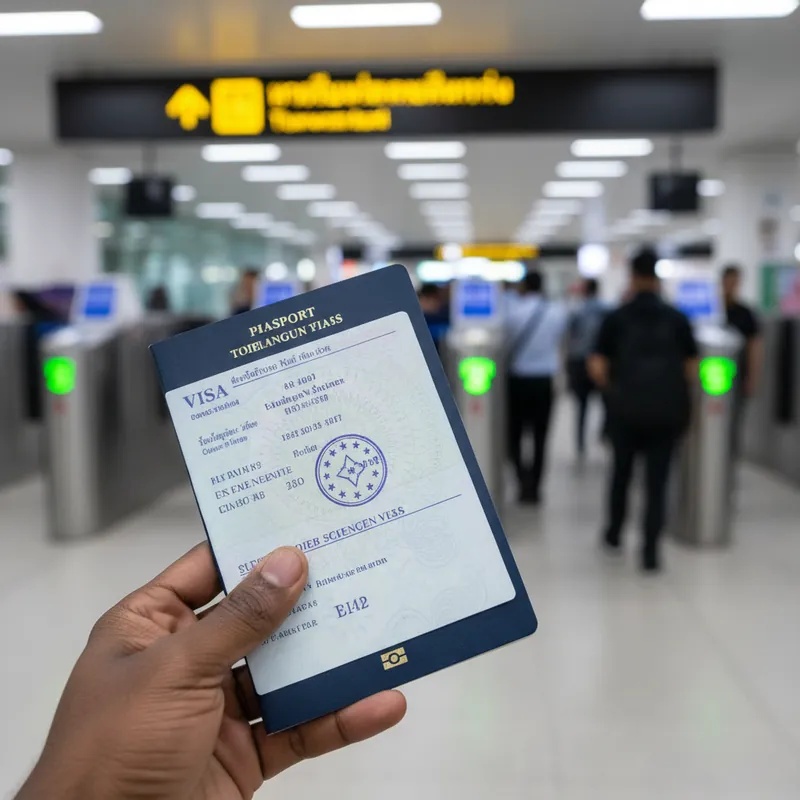
Schengen 90/180 Calculator — African passport
Enter your Schengen entry/exit dates below. The tool computes days used in the rolling 180-day window ending on the check date.
Days used
0 / 90
Days remaining
90
180-day window: —
Educational only. Verify with the official Schengen Visa Calculator (EU portal) before travel.
Schengen 90/180 Calculator for African Passport Holders 2026
For South African (SA), Nigerian (NG), Ghanaian (GH) and Kenyan (KE) passport holders, Europe in 2026 means the Schengen short-stay visa: €90 application fee, biometric appointment, plus an underappreciated rolling-window day-count rule that catches out frequent flyers more often than overstays from a single trip. This tool lays out the 29-country Schengen list, the per-embassy application steps for the four major African source markets, the 90/180 manual calculation method, and worked examples for the multi-trip scenarios that most often produce accidental overstays.
TL;DR: SA, NG, GH and KE ordinary passports all require a Schengen Type C short-stay visa before travel. 2026 fee: €90 adults / €45 children 6-11. Once issued, the 90/180 rule allows a maximum of 90 days inside the entire Schengen Area within any rolling 180-day backward window — not per country, not per calendar period. 29 Schengen states including Croatia (2023) and Bulgaria + Romania (full members since 1 Jan 2025); the only non-Schengen EU members are Ireland and Cyprus, which operate separate visa regimes. Multi-entry 1/3/5-year visas are routinely granted to applicants with clean travel history. Overstays are logged in SIS II and trigger 1-5 year refusal bans.
In this tool
- Schengen visa for African passports — overview
- The 29 Schengen countries + EU non-Schengen exceptions
- Application steps per embassy: SA, NG, GH, KE
- The 90/180 rule: manual calculation method + examples
- Multi-entry vs single-entry visa: when to ask for which
- Overstay penalties and the SIS II record
- Frequently asked questions
Schengen visa for African passports — overview {#overview}
The Schengen short-stay visa (Type C) is a uniform document recognised by all 29 member states. It is issued by the consulate of the country that is either (a) the main destination by number of days, or (b) the first country of entry if the time is distributed equally. SA, NG, GH and KE ordinary passport holders all sit on the EU’s Annex I list — visa required, no exemption. The Schengen visa permits short stays of up to 90 days within any rolling 180-day period for tourism, business, family visits, medical treatment, and short courses.
Key 2026 parameters:
| Parameter | 2026 value |
|---|---|
| Adult fee | €90 |
| Child 6-11 fee | €45 |
| Child under 6 fee | Free |
| Standard validity (first-time applicant) | Single-entry, dates of travel |
| Maximum stay per visa | 90 days |
| Multi-entry common validities | 1 year, 3 years, 5 years |
| Biometric storage period (VIS) | 59 months |
| Average processing time | 15 calendar days (can extend to 45) |
| Earliest submission | 6 months before departure |
The €90 fee is paid in local currency at the Visa Application Centre (VAC). It is non-refundable regardless of decision. Service-fee surcharges of approximately €30-45 are added by the outsourced VAC operator (TLScontact, VFS Global, BLS International — depending on the country and consulate).
The 29 Schengen countries + EU non-Schengen exceptions {#countries}
As of 2026, the Schengen Area comprises 29 European states (25 EU members plus Iceland, Norway, Switzerland and Liechtenstein). Only two EU members — Ireland and Cyprus — are NOT in Schengen, and they operate their own short-stay visa regimes; African passport holders need to plan for these separately.
Schengen Area (29 states) — single visa covers all
| State | Capital | ISO | Common African embassy footprint |
|---|---|---|---|
| Austria | Vienna | AT | Pretoria, Abuja, Nairobi |
| Belgium | Brussels | BE | Pretoria, Abuja, Accra, Nairobi |
| Bulgaria (full member since Jan 2025) | Sofia | BG | Pretoria |
| Croatia (since Jan 2023) | Zagreb | HR | Pretoria |
| Czech Republic | Prague | CZ | Pretoria, Abuja, Nairobi |
| Denmark | Copenhagen | DK | Pretoria, Abuja, Accra, Nairobi |
| Estonia | Tallinn | EE | Cairo (regional cover) |
| Finland | Helsinki | FI | Pretoria, Abuja, Nairobi |
| France | Paris | FR | Pretoria, Lagos, Accra, Nairobi |
| Germany | Berlin | DE | Pretoria, Lagos, Accra, Nairobi |
| Greece | Athens | GR | Pretoria, Abuja, Nairobi |
| Hungary | Budapest | HU | Pretoria, Abuja, Cairo |
| Iceland | Reykjavik | IS | via DK/NO consulates |
| Italy | Rome | IT | Pretoria, Lagos, Accra, Nairobi |
| Latvia | Riga | LV | Cairo |
| Liechtenstein | Vaduz | LI | via CH consulates |
| Lithuania | Vilnius | LT | Cairo, Pretoria |
| Luxembourg | Luxembourg | LU | via BE consulates |
| Malta | Valletta | MT | Cairo, Pretoria, Tripoli |
| Netherlands | Amsterdam | NL | Pretoria, Abuja, Accra, Nairobi |
| Norway | Oslo | NO | Pretoria, Abuja, Nairobi |
| Poland | Warsaw | PL | Pretoria, Abuja, Nairobi |
| Portugal | Lisbon | PT | Pretoria, Maputo, Abuja, Nairobi |
| Romania (full member since Jan 2025) | Bucharest | RO | Pretoria, Cairo |
| Slovakia | Bratislava | SK | Pretoria, Cairo |
| Slovenia | Ljubljana | SI | Pretoria, Cairo |
| Spain | Madrid | ES | Pretoria, Abuja, Lagos, Accra, Nairobi |
| Sweden | Stockholm | SE | Pretoria, Abuja, Accra, Nairobi |
| Switzerland | Bern | CH | Pretoria, Abuja, Accra, Nairobi |
EU but NOT Schengen — separate visa needed
| State | Visa regime |
|---|---|
| Ireland | Separate Irish short-stay visa (€60), valid only for Ireland |
| Cyprus | Separate Cypriot pro-visa (free online) for some, full visa for others |
The UK is outside both the EU and Schengen. Standard short stays for SA, NG, GH and KE passport holders to the UK require either an Electronic Travel Authorisation (ETA, where eligible) or a Standard Visitor Visa (£127 in 2026) — see our JNB-LHR South African Chicken Run guide for SA-specific UK-route context.
Application steps per embassy: SA, NG, GH, KE {#application-steps}
The mechanics are similar across the four origin markets but the practical VAC, fee mechanics and appointment lead times differ.
South Africa (SA passport holders)
Primary VAC operators in Pretoria / Johannesburg / Cape Town:
| Schengen state | VAC operator | Locations |
|---|---|---|
| France | VFS Global | Pretoria, Johannesburg, Cape Town, Durban |
| Germany | VFS Global | Pretoria, Johannesburg, Cape Town |
| Netherlands | VFS Global | Pretoria, Johannesburg, Cape Town |
| Spain | BLS International | Pretoria, Johannesburg, Cape Town |
| Italy | Capago | Pretoria, Johannesburg, Cape Town |
| Portugal | VFS Global | Pretoria, Johannesburg, Cape Town |
| Belgium | TLScontact | Pretoria, Johannesburg, Cape Town |
Typical SA workflow (Pretoria):
- Identify main destination by days. If equal, the first port of entry consulate handles the file.
- Complete the application form online at the consulate or VAC portal.
- Book the VAC biometric appointment. SA lead time in 2026: 2-6 weeks (longer May-Aug peak).
- Gather documents: passport (≥3 months validity beyond return + 2 blank pages); 2 recent biometric photos; flight reservation (not paid ticket); accommodation confirmation; bank statements (3-6 months); travel medical insurance ≥ €30,000; cover letter; employer letter / tax certificate.
- Attend appointment, pay €90 + service fee (~€35), submit biometrics.
- Wait 10-20 working days for decision; passport returned by courier or collection.
Nigeria (NG passport holders)
Primary VAC operators in Lagos / Abuja:
| Schengen state | VAC operator | Locations |
|---|---|---|
| France | TLScontact | Lagos, Abuja |
| Germany | VFS Global | Lagos, Abuja |
| Netherlands | VFS Global | Lagos, Abuja |
| Spain | BLS International | Lagos, Abuja |
| Italy | VFS Global | Lagos, Abuja |
| Belgium | TLScontact | Lagos, Abuja |
| Portugal | VFS Global | Lagos, Abuja |
| Switzerland | TLScontact | Lagos, Abuja |
Typical NG workflow (Lagos): identical document structure to SA but with additional emphasis on proof of strong ties to Nigeria (property ownership documents, business CAC certificate, family registration) given that first-time refusal rates from NG run higher than from SA. Lead times in 2026: 4-10 weeks at peak. The €90 fee is paid in NGN at the prevailing official rate set by the VAC daily, plus a TLS/VFS service fee of approximately NGN 25,000.
For diaspora-bound travel patterns specifically, see our LOS-JFK Naija diaspora US-routing guide — the LH/AF/KL routings via FRA, CDG and AMS all require Schengen transit visas for NG passport holders even if the final destination is the USA, unless the carrier provides explicit airside-transit clearance for the specific itinerary.
Ghana (GH passport holders)
Primary VAC operators in Accra:
| Schengen state | VAC operator | Address area |
|---|---|---|
| France | VFS Global | Airport Residential Area |
| Germany | VFS Global | Cantonments |
| Netherlands | VFS Global | Airport Residential Area |
| Spain | BLS International | Cantonments |
| Italy | VFS Global | Airport City |
Typical GH workflow (Accra): documents and timeline broadly track Nigeria but with shorter lead times (2-5 weeks typical) and consistently lower refusal rates. Fee paid in GHS at the prevailing rate. Many Ghana-based applicants submitting for France or Germany report 12-15 working day total processing for clean files.
Kenya (KE passport holders)
Primary VAC operators in Nairobi:
| Schengen state | VAC operator | Address area |
|---|---|---|
| France | VFS Global | Westlands |
| Germany | VFS Global | Westlands |
| Netherlands | VFS Global | Westlands |
| Spain | BLS International | Westlands |
| Italy | VFS Global | Karen |
| Switzerland | TLScontact | Westlands |
Typical KE workflow (Nairobi): the most efficient of the four markets in 2026 — average appointment lead time 1-3 weeks and refusal rates the lowest of the four. €90 paid in KES at the prevailing rate.
The 90/180 rule: manual calculation method + examples {#calculation}
The 90/180 rolling-window rule is the part of the Schengen system that most often catches frequent travellers. It is not a calendar-year rule. It is not a per-country rule. It is a rolling 180-day backward-looking window: at any moment you are inside Schengen, the cumulative days inside any combination of the 29 states across the previous 180 days must not exceed 90.
Manual calculation steps
- Pick the date you want to test — typically the planned date of your next Schengen entry.
- Count back 180 calendar days from that test date. Mark this as the window-start date.
- List every prior Schengen entry and exit stamp within the window. The day of entry counts as day 1; the day of exit also counts. A same-day entry-and-exit counts as 1 day.
- Sum the days across all prior trips that fall inside the window. Days from trips that exited before the window-start are not counted (even if part of that trip overlapped the window, only the in-window portion counts).
- Calculate remaining allowance = 90 minus the sum from step 4. This is the maximum continuous stay you can begin on the test date without crossing the 90-day ceiling.
The official European Commission Schengen Visa Calculator (free, at ec.europa.eu/home-affairs/policies/schengen-borders-and-visa) performs this calculation automatically and is the reference standard if a manual count disagrees.
Worked example 1 — straightforward business traveller
Charlotte (Ghana passport, Schengen 1-year multi-entry visa) wants to enter Paris (CDG) on 1 September 2026 for a 21-day trip.
- Window start: 180 days back = 5 March 2026.
- Prior trips within window: 10-25 April 2026 (16 days, Berlin); 12-22 June 2026 (11 days, Rome).
- Total in-window days used: 16 + 11 = 27 days.
- Remaining allowance from 1 Sept: 90 - 27 = 63 days.
- Planned 21-day Sept trip fits comfortably with 42 days remaining for future use within the (then-still-rolling) window.
Worked example 2 — borderline case requiring re-entry timing
Tunde (Nigeria passport, Schengen 3-year multi-entry visa) wants to enter Frankfurt (FRA) on 15 November 2026 for a 30-day trip.
- Window start: 180 days back = 19 May 2026.
- Prior trips within window: 1 July - 27 Aug 2026 (58 days, multi-country tour); 10-22 Oct 2026 (13 days, Spain).
- Total in-window days used: 58 + 13 = 71 days.
- Remaining allowance from 15 Nov: 90 - 71 = 19 days.
- Planned 30-day Nov trip would overstay by 11 days. Tunde must either shorten the trip to 19 days, postpone entry until enough July days fall outside the rolling window (which happens day-by-day starting 27 December), or split the planned trip into two segments straddling the 27 December window roll-off.
Worked example 3 — accidental overstay scenario
Sello (SA passport, Schengen 5-year multi-entry visa) enters Amsterdam (AMS) on 5 January 2026 intending a 90-day stay. He prior-travelled to Italy for 15 days in November 2025 and forgot.
- Window start (test date 5 Jan): 180 days back = 9 July 2025.
- Prior trips in window: 14-28 Nov 2025 (15 days, Rome).
- Total in-window: 15 days.
- Remaining allowance from 5 Jan: 90 - 15 = 75 days, not 90.
- Sello believed he had 90 days available; he actually has 75. If he stays the full intended 90 days he will overstay by 15 days, triggering an SIS II flag and likely a 1-3 year refusal ban on his next application. The correct action: exit on or before day 75 (20 March 2026).
This third case is by far the most common accidental-overstay pattern: a traveller assumes the new trip resets the clock because the prior trip felt “long ago,” when in fact it sits well within the 180-day window. Always re-check before booking.
Multi-entry vs single-entry visa: when to ask for which {#multi-entry}
Schengen visas are issued in three common validity bands. The consular decision is based on (a) travel history, (b) declared travel pattern, (c) financial stability evidence, and (d) the issuing state’s own multi-entry policy.
| Visa type | Validity | Typical recipient profile | Practical use case |
|---|---|---|---|
| Single-entry (SEV) | Trip dates only | First-time applicant, no prior travel | One-off conference, family event, single tour |
| Multi-entry 1-year (MEV-1) | 1 year, 90/180 limit | Second-time applicant with clean SEV record | Regular biannual business trips |
| Multi-entry 3-year (MEV-3) | 3 years, 90/180 limit | Established traveller with 2+ clean Schengen records | Frequent business travel, distributed family ties |
| Multi-entry 5-year (MEV-5) | 5 years, 90/180 limit | Long-standing traveller with substantial clean history | Senior executives, recurring contractors, well-established traders |
Practical guidance for African applicants:
- On the first application, ask explicitly in the cover letter for the longest validity you can justify (e.g. “I respectfully request a 1-year multi-entry visa given my pattern of three planned trips in 2026”). Consulates routinely match or shorten — they rarely upgrade unrequested.
- Apply to a state with multi-entry-friendly policy. France, Germany, Netherlands, Spain and Italy are generally regarded as the most generous on multi-entry; Switzerland and Norway tend to be tighter on first-time issuance.
- Multi-entry does not extend the 90-day limit. It only removes the requirement to re-apply for each trip.
- A multi-entry visa that expires while you are inside Schengen does not extend your stay — you must exit before the 90/180 cap regardless.
Overstay penalties and the SIS II record {#overstays}
Schengen overstay enforcement runs through the Schengen Information System (SIS II), an interconnected database queried at every external Schengen border. Common consequences:
| Overstay length | Typical consequence |
|---|---|
| 1-3 days | Annotation in passport, verbal warning, no fine in most member states |
| 4-15 days | Fine on departure (DE €100-500, FR €198, IT €500+), SIS II flag, future visa applications scrutinised |
| 16-90 days | Fine €500-3,000, SIS II flag, 1-3 year visa refusal pattern likely |
| 90+ days | Fine up to €5,000 (IT), formal entry ban under Schengen Borders Code Art. 11, 3-5 year refusal pattern |
SIS II record duration: overstays typically generate an alert that remains queryable for 3 years from the date of the violation. New visa applications during that window are not automatically refused, but they face a substantially higher scrutiny bar and a heavier evidentiary requirement.
Self-reporting before exit: member states routinely treat a self-reported, documented overstay (medical certificate, force majeure proof, missed-flight evidence with carrier confirmation) far more leniently than one discovered at the departure border. The practical step is to visit the local police or migration office before the overstay starts and request a documented extension or a formal certificate of force majeure.
Frequently asked questions {#faq}
1. Do SA, NG, GH, KE passport holders need a Schengen visa in 2026? Yes. South African, Nigerian, Ghanaian and Kenyan ordinary passport holders all require a Schengen short-stay (Type C) visa before travel. The 2026 application fee is €90 for adults and €45 for children aged 6-11. Diplomatic and service passport holders from some of these countries have separate bilateral arrangements with specific Schengen states and should consult the relevant embassy directly.
2. How does the 90/180 rolling-window rule actually work? The 90/180 rule means that on any given day inside the Schengen Area, you may not have spent more than 90 days inside Schengen across the previous 180 days. It is a rolling, backward-looking window — not a calendar period and not a per-country counter. Days inside any combination of the 29 Schengen states all count toward the same 90-day total. The European Commission publishes a free official Schengen calculator at ec.europa.eu/home-affairs that performs this calculation.
3. Are biometrics re-used across Schengen visa applications? Yes. Once biometrics (10 fingerprints + a digital photograph) have been captured at a Schengen consulate or accredited Visa Application Centre, they are stored in the Visa Information System (VIS) for 59 months. Subsequent Schengen visa applications during that period generally do not require a new biometric appointment, although individual consulates retain discretion to request a fresh appointment if a quality issue exists with the stored record.
4. Can a family receive a single multi-entry Schengen visa? Each family member receives an individual visa — there is no joint family Schengen visa. However, applications can be submitted together at one VAC appointment and processed in parallel, and multi-entry visas of 1, 3, or 5-year validity are routinely issued to applicants with a clean prior-travel history. Children must have their own application file, biometric capture (if aged 12+) and supporting documents.
5. What are the consequences of overstaying a Schengen visa? Overstays are recorded in the Schengen Information System (SIS II) at exit. Typical consequences include a refusal of future Schengen visa applications for 1-5 years, an exit-stamp annotation flagging the overstay to other Schengen consulates, a fine on departure (varies by country: Germany up to €3,000, France typically €198, Italy €5,000+ at the upper end), and in some cases a formal entry ban under the Schengen Borders Code. Self-reporting an unintended overstay before exit and providing documented justification (medical, force majeure) often results in a far milder outcome than discovery at the border.
Planning your African-European travel in 2026
For most African passport holders, the Schengen visa is a once-off administrative cost that opens a 29-country region for repeated use over 1, 3 or 5 years. The two key disciplines are (1) applying through the embassy of the main-stay country with a well-justified multi-entry request, and (2) tracking the rolling 90/180 day count carefully — particularly for travellers with multiple short business trips per year.
For currency planning on European trips see our USD-ZAR-NGN-KES-GHS multi-currency reference. For corridor-specific fare and routing analysis, the major African-European pairs are covered in dedicated route guides such as JNB-CDG via Air France and LOS-CDG. For airline-level cabin, baggage and frequent-flyer detail, the Air France, Lufthansa and KLM pages each include the 2026 fare-curve seasonality and African-origin booking conventions.
Start your African-European trip planning at our main African flight search page with live multi-city fare comparison.