African Hajj Quota Tracker 2026: NAHCON, SAHUC, KAHCON, GHC
Each year the Saudi Ministry of Hajj and Umrah allocates approximately 1.6 million Hajj quota slots globally. African Muslim-majority and Muslim-minority countries collectively receive around 115,000 of these — distributed to national Hajj authorities who then sub-allocate within each country by state, province or region. This 2026 tracker covers the seven main African Hajj boards: NAHCON (Nigeria), SAHUC (South Africa), KAHCON (Kenya), GHC (Ghana), UMSC (Uganda), BAKWATA (Tanzania) and MSCZ (Zimbabwe). It documents quota size, sub-allocation pattern, the Saudi-Ministry timing cycle, typical package cost, and the registration and refund mechanics each board operates.
TL;DR: 2026 African Hajj quotas: Nigeria 95,000 (NAHCON) — 2nd largest globally after Indonesia; South Africa 3,200 (SAHUC); Kenya 5,000 (KAHCON); Ghana 6,200 (GHC); Uganda ~700 (UMSC); Tanzania ~2,000 (BAKWATA); Zimbabwe ~150 (MSCZ). Saudi Ministry timeline: announcement Oct-Nov 2025, country-level finalisation Jan-Mar 2026, visa issuance Mar-Apr 2026. 2026 Hajj dates: late May to early June (Dhul Hijjah 1447 AH, subject to Saudi moon sighting). Typical 2026 standard package costs: NG ~USD 5,500-6,150, SA ~USD 5,700-7,800, KE ~USD 5,500-6,750, GH ~USD 6,050-7,950.
In this tool
- Saudi Ministry of Hajj allocation cycle
- Nigeria — NAHCON 95,000 quota + state distribution
- South Africa — SAHUC 3,200 quota
- Kenya — KAHCON 5,000 quota
- Ghana — GHC 6,200 quota
- Uganda, Tanzania, Zimbabwe — smaller-quota boards
- Frequently asked questions
Saudi Ministry of Hajj allocation cycle {#saudi-cycle}
The Saudi Ministry of Hajj and Umrah (Ministry of Hajj for short) sets the global Hajj quota each year based on the operational capacity of Makkah and Mina during the pilgrimage rites. The benchmark allocation principle is 1,000 pilgrims per 1 million Muslim population per country, though small-Muslim-population countries receive a minimum allocation and the largest Muslim populations sometimes negotiate slightly above-formula adjustments.
Annual Saudi cycle for African pilgrim boards
| Month (Gregorian) | Saudi Ministry milestone | African board action |
|---|---|---|
| October-November (year before Hajj) | Annual quota letters issued to ministries of religious affairs of each country | National Hajj boards begin internal allocation work |
| December-January | Bilateral Hajj Agreement (BHA) signed between Saudi Ministry and each country | Saudi Ministry confirms quota; African boards publish national packages |
| January-March | State / regional sub-allocation finalised within each African country | Pilgrim registration finalised, payments collected, accommodation contracted |
| March-April | Saudi visa issuance commences | Final visa stamping, biometric capture (if not pre-captured), flight manifests confirmed |
| Late April-May | Pilgrim flight departures begin (~21 days before Hajj rites) | Hajj-charter flights operating Africa-JED and Africa-MED |
| Late May - Early June 2026 (Dhul Hijjah 8-12) | Hajj rites: Mina, Arafah, Muzdalifah, stoning, Tawaf | Pilgrims complete rites |
| June-July | Return flights | Hajj-return flights operating JED-Africa |
The exact 2026 Hajj dates depend on Saudi moon sighting confirmation; the Islamic month of Dhul Hijjah 1447 AH is expected to begin around 20 May 2026 with the climactic Day of Arafah on or around 28 May 2026.
African quota summary 2026
| Country | National Hajj board | 2026 quota | African share % |
|---|---|---|---|
| Nigeria | NAHCON | 95,000 | 82.6% |
| Ghana | GHC | 6,200 | 5.4% |
| Kenya | KAHCON | 5,000 | 4.3% |
| South Africa | SAHUC | 3,200 | 2.8% |
| Tanzania | BAKWATA | ~2,000 | 1.7% |
| Uganda | UMSC | ~700 | 0.6% |
| Zimbabwe | MSCZ | ~150 | 0.1% |
| Other African (DRC, Mozambique, Ethiopia, etc.) | Various | ~3,000 combined | ~2.6% |
| African total | ~115,000 | 100% |
For comparison, Indonesia’s 2026 quota is approximately 221,000 (the largest globally), Pakistan 179,000, India 175,000, Bangladesh 127,000. Nigeria’s 95,000 places it as the fifth-largest national Hajj contingent globally and the largest in Africa by a wide margin.
Nigeria — NAHCON 95,000 quota + state distribution {#nigeria}
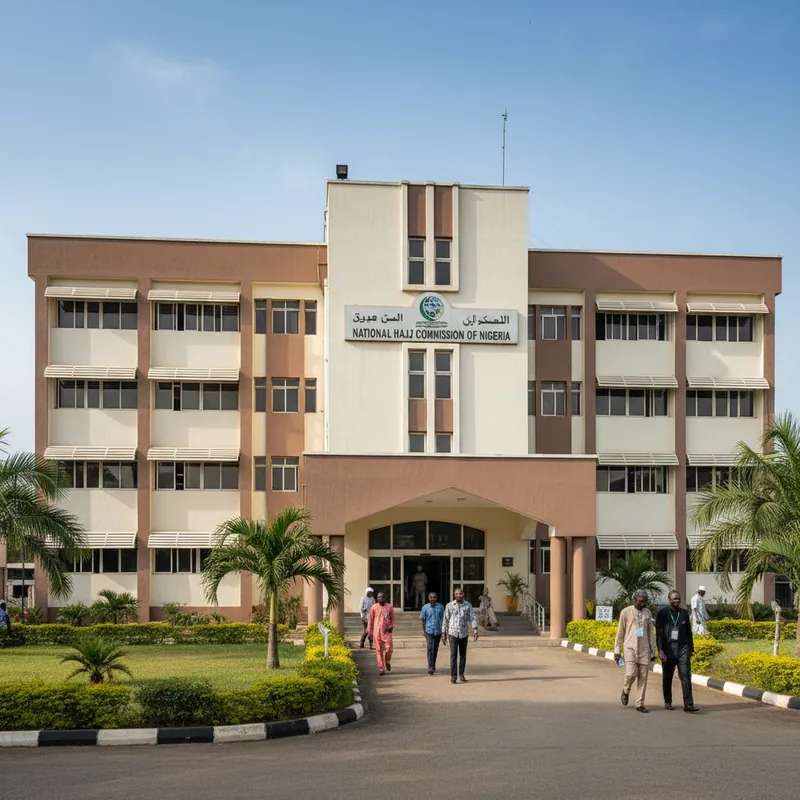
The National Hajj Commission of Nigeria (NAHCON) is a federal statutory commission established by the National Hajj Commission Act 2006. NAHCON manages the Saudi-Arabia-side logistics — accommodation contracting in Makkah and Madinah, transport coordination, aircraft chartering through Nigerian Civil Aviation Authority approval — while each State Pilgrims Welfare Board manages local registration, screening, training and routing within the 36 states + FCT.
Indicative 2026 state-level quota distribution
NAHCON sub-allocates Nigeria’s 95,000 in proportion to documented Muslim population per state. The May 2026 indicative distribution for the larger Muslim-population states is roughly:
| State | 2026 quota (indicative) | Pilgrim Welfare Board HQ |
|---|---|---|
| Kano | 9,500 | Kano |
| Lagos | 6,500 | Lagos Island |
| Borno | 5,800 | Maiduguri |
| Bauchi | 5,200 | Bauchi |
| Kaduna | 5,000 | Kaduna |
| Sokoto | 4,600 | Sokoto |
| Kebbi | 4,200 | Birnin Kebbi |
| Katsina | 4,000 | Katsina |
| Jigawa | 3,800 | Dutse |
| Yobe | 3,200 | Damaturu |
| Zamfara | 3,000 | Gusau |
| Niger | 2,800 | Minna |
| Adamawa | 2,600 | Yola |
| Gombe | 2,400 | Gombe |
| Kwara | 2,200 | Ilorin |
| Plateau | 2,100 | Jos |
| Nasarawa | 1,800 | Lafia |
| Taraba | 1,800 | Jalingo |
| Oyo | 1,600 | Ibadan |
| Ogun | 1,400 | Abeokuta |
| Other 17 states + FCT | Balance | Various |
2026 NAHCON package cost (indicative)
| Component | Cost (NGN, indicative) | USD equivalent |
|---|---|---|
| Standard NAHCON package (all-in) | NGN 8.5-9.5 million | USD 5,500-6,150 |
| BTA (Basic Travel Allowance) — pilgrim’s spending money in SAR | SAR 1,500 equivalent | USD 400 |
| Charter Hajj flight cost (chargeable component) | ~NGN 2.8-3.5 million | USD 1,800-2,250 |
For specifically the Hajj flight carrier comparison Air Peace vs Saudia from LOS, see our Lagos-Jeddah Nigerian Hajj guide and the NAHCON 2026 quota allocation timing breakdown.
Registration and screening sequence
The standard NAHCON-coordinated pilgrim journey is:
- Local State Pilgrims Welfare Board registration (typically September-October before Hajj year)
- Initial deposit payment (NGN 1-2 million in some states)
- Medical screening including yellow-fever and meningitis vaccination
- Final payment of package balance (January-February)
- Saudi visa application via NAHCON-managed channel (March)
- Biometric capture if not previously captured
- Pre-departure training (manasik) at state level
- Flight assignment to NAHCON-chartered carrier (Air Peace, Max Air, Aero Contractors, with Saudia handling some manifests)
- Departure typically 14-21 days before 8 Dhul Hijjah
South Africa — SAHUC 3,200 quota {#sa}
The South African Hajj and Umrah Council (SAHUC) is a non-statutory pilgrim representative body recognised by the Saudi Ministry of Hajj as the authority for South African Hajj coordination. SAHUC accredits a tier of private South African Hajj operators who deliver the pilgrim packages.
2026 SAHUC structure
- Total quota: 3,200
- Allocation method: registration + draw with priority weighting for first-time pilgrims
- Accredited operators (2026): approximately 30 SAHUC-licensed Hajj operators across Gauteng, Western Cape, KwaZulu-Natal and Eastern Cape
2026 SAHUC package cost bands
| Tier | Cost (ZAR) | USD equivalent | Accommodation |
|---|---|---|---|
| Economy (shared, walking distance) | ZAR 105,000-125,000 | USD 5,700-6,750 | 8-12-bed shared room, 5-7 minute walk to Haram |
| Standard | ZAR 125,000-145,000 | USD 6,750-7,800 | 4-bed shared, 3-5 minute walk |
| Premium | ZAR 145,000-185,000 | USD 7,800-10,000 | Double room, hotel-tier accommodation |
| VIP | ZAR 185,000-250,000+ | USD 10,000+ | Suite, Haram-view, private transport |
For the JNB-JED carrier mechanics see our Johannesburg-Jeddah Saudia vs Emirates vs Ethiopian SA Hajj guide.
SAHUC registration timeline
| Month | Action |
|---|---|
| August-October (prior year) | SAHUC opens registration via accredited operators |
| October | Draw weighting and quota allocation per operator |
| November-January | Pilgrim confirmation, deposit collection |
| February-March | Saudi visa application, biometric capture |
| April-May | Final manasik training, final flight assignment |
Kenya — KAHCON 5,000 quota {#kenya}
The Kenya Hajj Council (KAHCON) — sometimes written as Kenya Hajj Commission — operates as a coordination body under the Ministry of Interior with Saudi Ministry recognition. It manages Kenya’s 5,000 annual quota distributed among Kenyan Muslim communities concentrated primarily in Mombasa, Nairobi, the North Eastern Region, and Lamu.
2026 KAHCON structure
- Total quota: 5,000
- Major sub-regions: Mombasa County (~1,400), Nairobi County (~1,000), Garissa (~700), Mandera (~600), Wajir (~500), Lamu (~250), Kwale (~250), other counties balance
- Accredited operators: approximately 15 Hajj operators registered with KAHCON
- Primary carrier from NBO: Saudia (SV) direct NBO-JED + Kenya Airways (KQ) connecting via DXB or DOH on Hajj-charter arrangements
2026 KAHCON package cost
| Tier | Cost (KES) | USD equivalent |
|---|---|---|
| Standard | KES 720,000-820,000 | USD 5,500-6,300 |
| Premium | KES 820,000-1,000,000 | USD 6,300-7,700 |
| VIP | KES 1,000,000+ | USD 7,700+ |
For NBO-JED carrier mechanics see our Nairobi-Jeddah KAHCON Kenya Hajj routing guide.
Ghana — GHC 6,200 quota {#ghana}
The Ghana Hajj Board (sometimes referred to as GHC — Ghana Hajj Commission) operates under the Office of the National Chief Imam coordinating with Ghanaian regional Muslim councils. Ghana’s 2026 quota of 6,200 places it third in Africa after Nigeria and slightly above Kenya.
2026 GHC structure
- Total quota: 6,200
- Sub-allocation: regional, with the strongest pilgrim concentrations in Northern Region, North East Region, Savannah Region, Upper East, Upper West, Ashanti (Kumasi Muslim community) and Greater Accra
- Primary departure: Kotoka International Airport (ACC) on Hajj-charter and Saudia scheduled service to Jeddah
2026 GHC package cost
| Tier | Cost (GHS) | USD equivalent |
|---|---|---|
| Standard | GHS 88,000-105,000 | USD 6,050-7,250 |
| Premium | GHS 105,000-130,000 | USD 7,250-8,950 |
For the ACC-JED routing details see our Accra-Jeddah Ghana Hajj Board pilgrim guide.
Uganda, Tanzania, Zimbabwe — smaller-quota boards {#smaller}
Uganda — UMSC (~700 quota)
The Uganda Muslim Supreme Council (UMSC) coordinates Uganda’s Hajj quota of approximately 700 pilgrims, allocated primarily to Buganda, Eastern, and Western regions. Standard package cost 2026: UGX 22-27 million (USD 5,850-7,200). Typical routing: Entebbe (EBB) - DXB - JED on Emirates (EK) Hajj-pricing OR EBB-NBO-JED on Saudia / Kenya Airways code-share.
Tanzania — BAKWATA (~2,000 quota)
The National Muslim Council of Tanzania (BAKWATA — Baraza Kuu la Waislamu wa Tanzania) manages Tanzania’s quota of approximately 2,000. Sub-allocation across Zanzibar, Dar es Salaam, Tanga, Mwanza, Kigoma and other regions. 2026 package cost: TZS 14-18 million (USD 5,400-6,900). Typical routing: Dar es Salaam (DAR) - DXB - JED on Emirates, or DAR - DOH - JED on Qatar Airways (QR) Hajj-charter where available.
Zimbabwe — MSCZ (~150 quota)
The Muslim Supreme Council of Zimbabwe manages Zimbabwe’s small Hajj quota of approximately 150 pilgrims. The Muslim community in Zimbabwe is small (under 1% of population) but established, centred in Harare and Bulawayo. Typical routing: Harare (HRE) - JNB - JED on South African Airways (SAA) + Saudia code-share, or HRE-DXB-JED on Emirates.
Other African boards
Smaller African Hajj allocations (totalling approximately 3,000 across the continent) are distributed to DRC, Mozambique, Ethiopia, Malawi, Zambia, Namibia, Botswana, Cameroon, and other African Muslim-minority countries via their respective Islamic councils.
Frequently asked questions {#faq}
1. How is the African Hajj quota allocated each year? The Saudi Ministry of Hajj and Umrah allocates an annual global Hajj quota of approximately 1.6 million pilgrims, distributed by country at a ratio of 1,000 pilgrims per 1 million Muslim population. African countries collectively receive around 115,000 of the global allocation. The country totals are then distributed within each country by the national Hajj authority — NAHCON in Nigeria, SAHUC in South Africa, KAHCON in Kenya, GHC in Ghana, UMSC in Uganda, BAKWATA in Tanzania, MSCZ in Zimbabwe — typically by state, province, or region in proportion to local Muslim population. Saudi Ministry announcement typically occurs October-November; country-level distribution finalises January-March; visa issuance March-April.
2. What is the 2026 Hajj season timing? The 2026 Hajj falls in the Islamic month of Dhul Hijjah 1447 AH, expected late May to early June 2026 by Gregorian calendar (8-12 Dhul Hijjah corresponds to approximately 27-31 May 2026 with confirmed dates depending on Saudi moon sighting). African pilgrim flights typically begin departing the home country 10-21 days before the start of Hajj rites and return 7-14 days after, producing the main Africa-Jeddah / Africa-Madinah peak pilgrim flow from mid-May through mid-June 2026.
3. How are state-level Hajj quotas distributed within Nigeria? NAHCON distributes Nigeria’s 95,000 Hajj quota across the 36 states + FCT in proportion to documented Muslim population. The largest state quotas in 2026 are Kano (~9,500), Lagos (~6,500), Borno (~5,800), Bauchi (~5,200), Kaduna (~5,000), Sokoto (~4,600), Kebbi (~4,200), Katsina (~4,000), Jigawa (~3,800), Yobe (~3,200) and Zamfara (~3,000). Each State Pilgrims Welfare Board manages the local registration, screening, training and routing. NAHCON itself manages the Saudi-side logistics, aircraft chartering through the Nigerian Civil Aviation Authority, and accommodation contracting in Makkah and Madinah.
4. What is the typical 2026 African Hajj package cost? 2026 African Hajj package costs vary widely by country and accommodation tier. Nigerian NAHCON-standard package: approximately NGN 8.5-9.5 million (USD 5,500-6,150). South African SAHUC accredited package: ZAR 105,000-145,000 (USD 5,700-7,800). Kenyan KAHCON package: KES 720,000-880,000 (USD 5,500-6,750). Ghanaian GHC package: GHS 88,000-115,000 (USD 6,050-7,950). Uganda UMSC: UGX 22-27 million (USD 5,850-7,200). Premium private packages from approved tour operators add 30-100% above national standard packages. All include round-trip Africa-Jeddah airfare, Makkah-Madinah accommodation, transport, basic meals, training and Saudi visa.
5. Can a Hajj pilgrim get a refund if they cannot travel? All four major African Hajj boards (NAHCON, SAHUC, KAHCON, GHC) operate published refund policies with deadlines and forfeiture tiers. Typical structure: full refund minus administration fee if cancellation occurs 90+ days before the scheduled departure; partial refund (50-70%) at 60-89 days; minimal refund (20-30%) at 30-59 days; no refund within 30 days of departure unless force majeure (medical emergency with certified documentation, death in family) is proven. Quota slots forfeited under cancellation typically pass to a waiting-list pilgrim from the same state or region. Always read the specific year’s terms — board-published refund schedules are updated annually.
Planning your African Hajj 2026 journey
For African Muslim pilgrims, the 2026 Hajj will be the standard religious peak across the Africa-Jeddah and Africa-Madinah corridors with charter flights operating from late May through mid-June. Cost variation is real and substantial — between the standard national-board package and premium private tour operator packages — but the underlying Saudi-side logistics (Mina tent assignment, transport, Mashair train allocation) follow the national board structure regardless.
For carrier-level baggage allowances and Hajj-uplift policy (Saudia adds 46kg for Hajj pilgrims; Air Peace, Ethiopian and Kenya Airways have their own Hajj-charter allowance structures) see our African carrier baggage comparator. For the LOS-JED, JNB-JED, NBO-JED, ACC-JED corridor fare and routing analysis, the country-specific guides linked in each section above cover schedule, charter operator and Saudi visa stamping mechanics.
Start your Hajj-corridor flight search on our main African flight search page.