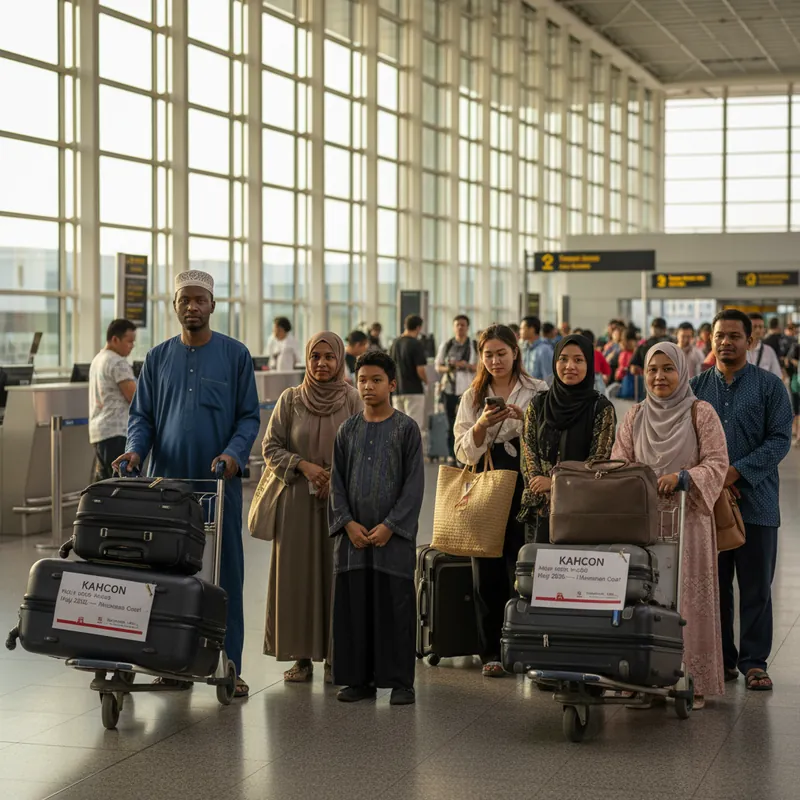
KAHCON Kenya Hajj: Mombasa Pilgrim Quota, NBO → JED Routes
Kenya’s Hajj operation is administered by the Kenya Akhlaq Hajj Council (KAHCON), which coordinates a Saudi-allocated quota of approximately 5,000 places annually. Kenyan Muslims — approximately 11 percent of the national population, or roughly 5.5-6 million people — are concentrated in two distinct geographic clusters: the historic Swahili-Arab coastal communities of Mombasa, Lamu and the wider Coast Province, and the Somali Kenyan communities of the North Eastern Province plus the Eastleigh district of Nairobi. This guide is maintained across cycles and unpacks the KAHCON quota structure, the NBO and MBA to Jeddah flight options, and the realistic cost breakdown for the Kenyan pilgrim. Because the Hajj follows the lunar calendar it falls about eleven days earlier each Gregorian year (the 2026 rites fell in late May, the next cycle is expected mid-May 2027), so the mechanics below apply whichever cycle you are planning for; registration runs through KAHCON-accredited operators ahead of each pilgrimage.
TL;DR: Kenya Hajj 2026 package cost lands in the $2,500-4,000 (KES 320,000-510,000) range per pilgrim. The flight component is approximately $700-1,100 (KES 90,000-140,000) on NBO-JED direct via Kenya Airways or Saudia, or via DXB on Emirates. KAHCON administers the Saudi quota of approximately 5,000 places through accredited operators concentrated in Nairobi and Mombasa. Kenya’s coastal Swahili-Arab Muslim heritage in Mombasa and Lamu dates to the 8th century. Hajj is the 5th pillar of Islam — the procedural structure described here exists to make the journey safe and predictable.
In this guide
- KAHCON and the 5,000-place Kenya quota
- Kenyan Muslim communities: Coast and North Eastern
- NBO-JED and MBA-JED flight options
- Kenya Airways Hajj charter product
- Total cost breakdown $2,500-4,000
- Three pilgrim case studies
- Frequently asked questions
How is the 5,000-place Kenya Hajj quota allocated each year? {#kahcon-quota}
The Kenya Akhlaq Hajj Council (KAHCON) is the body recognised by the Saudi Ministry of Hajj and Umrah as the official counterpart for Hajj visa allocation for Kenyan pilgrims. It administers the Saudi-allocated quota of approximately 5,000 places (reviewed for each Hajj year) and operates through a panel of accredited Kenyan Hajj operators.
The Saudi quota is calculated using the standard 1:1,000 Muslim-population formula. Kenya’s Muslim population — most authoritative estimates place it at 10-11 percent of the country’s roughly 55 million people — yields the 5,000 quota allocation. The figure is reviewed annually and was reduced in the pandemic years 2020-2021 before reverting to standard levels.
KAHCON distributes the 5,000 quota across approximately 40-50 accredited operators, with the largest geographic concentrations in:
- Nairobi metropolitan area — approximately 35-40 percent of the allocation, serving the diverse Muslim community of Eastleigh (predominantly Somali Kenyan), South C, South B, and the wider Nairobi cohort
- Mombasa and the Coast Province — approximately 30-35 percent, serving the Swahili-Arab heritage communities of Mombasa Old Town, Malindi, Lamu and the Kilifi corridor
- North Eastern Province (Garissa, Wajir, Mandera) — approximately 15-20 percent, serving the predominantly Somali Kenyan border communities
- Other — Kisumu, Nakuru, Eldoret and smaller centres
A Kenyan pilgrim applies through a KAHCON-accredited operator who submits documentation to KAHCON for visa batching to the Saudi Ministry of Hajj via the Nusuk platform.
Kenyan Muslim communities: Coast and North Eastern {#kenya-muslim-communities}
The Kenyan Muslim community is not a single homogeneous group. It comprises three principal historical strands, each with its own Hajj tradition.
Swahili-Arab Coast Province
The Coast Province communities of Mombasa, Lamu, Malindi and the Kilifi corridor are the oldest established Muslim communities in East Africa, with continuous Islamic presence dating to the 8th and 9th centuries through Indian Ocean trade routes connecting the East African coast with the Arabian peninsula. Mombasa Old Town’s mosques include several with histories stretching back to the 14th-16th centuries. Lamu — a UNESCO World Heritage Site — is one of the oldest continuously inhabited Swahili settlements and remains a centre of traditional Islamic scholarship. The Swahili-Arab community combines Swahili language and culture with Arab heritage; many family lineages trace ancestry to Yemen, Oman and the Hadhramaut.
The Coast Province cohort is typically organised through KAHCON-accredited operators based in Mombasa Old Town and Malindi, with strong family-cohort and mosque-based group bookings, cycle after cycle.
Somali Kenyan North Eastern Province
The Somali Kenyan community of the North Eastern Province (Garissa, Wajir, Mandera) plus the urban Somali-Kenyan diaspora of Eastleigh in Nairobi forms a substantial second strand. The community’s Muslim identity is integrated with Somali clan and family structures, and Hajj is traditionally a multi-generational community milestone, with elders supported by extended family contributions.
KAHCON-accredited operators serving this cohort are typically based in Eastleigh and in Garissa town, with logistics adapted to the cross-border family structures common in the North Eastern communities.
Other Kenyan Muslim communities
A third strand includes Kenyan Muslims of Indian and Pakistani heritage (concentrated in Nairobi’s old commercial districts), inland Muslim communities scattered across Western Kenya and the Rift Valley, and converts from various Kenyan ethnic groups. Together this strand accounts for approximately 15-20 percent of the KAHCON allocation.
Which NBO → JED and MBA → JED flights serve Kenyan pilgrims? {#flight-options}
| Routing | Carrier | Aircraft | One-way USD (typical) | Duration |
|---|---|---|---|---|
| NBO-JED direct | Kenya Airways (KQ) | Boeing 787-8 Dreamliner | $700-900 | 5h 30m |
| NBO-JED direct | Saudia (SV) | Boeing 777-300ER | $750-950 | 5h 45m |
| NBO-DXB-JED | Emirates (EK) | Boeing 777 + 777 | $650-850 | 9-11h with DXB layover |
| MBA-NBO-JED | KQ + KQ | E190 + 787 | $800-1,000 | 8-9h with NBO connection |
| NBO-ADD-JED | Ethiopian (ET) | 737/A350 + 787 | $600-800 | 9-11h with ADD layover |
Key observations:
- Kenya Airways NBO-JED direct is the most common KAHCON Hajj routing. KQ’s Boeing 787-8 Dreamliner offers a modern cabin product with lower cabin altitude pressure than older equipment — particularly valuable for elderly pilgrims. The 5h 30m flight time is one of the shortest African-origin Hajj rotations to Jeddah.
- Saudia NBO-JED direct is the alternative direct option, with the operational advantage that Saudia’s JED ground handling at its home base is efficient for pilgrim throughput at the dedicated Hajj terminal.
- Emirates via DXB offers a slightly lower seat rate in some shoulder weeks but adds the DXB layover. The Emirates A380 (where deployed) and 777 cabin product is consistently well-rated.
- Ethiopian via ADD is the lowest-cost option in some weeks; ADD is a major African hub and the Ethiopian 787 Dreamliner offers a comparable modern cabin product.
- Mombasa origin typically requires a NBO connection on Kenya Airways’ regional fleet (Embraer 190 or Boeing 737), then onto the NBO-JED leg. Some KAHCON operators charter supplementary MBA-JED rotations in high-demand years, but in 2026 the standard routing is via NBO.
Kenya Airways Hajj charter product {#kenya-airways-product}
Kenya Airways (KQ) is typically the largest single carrier for the KAHCON Hajj airlift, deploying its Boeing 787-8 Dreamliner fleet on the NBO-JED rotation. The carrier supplements its daily scheduled NBO-JED service with charter rotations during the pre-Hajj airlift window each cycle.
Cabin and seat
The KQ 787-8 is configured 3-3-3 in economy with a small business-class cabin retained on most charter rotations for senior delegation pilgrims and the KAHCON liaison cohort. Seat pitch in economy is 31-32 inches, which is comfortable for the short 5h 30m rotation. The Dreamliner’s lower cabin altitude (approximately 6,000 feet equivalent versus 8,000 feet on older 777s and 747s) and higher cabin humidity reduce fatigue on arrival — useful for the immediate post-flight transit to Mecca.
Meal and prayer service
Kenya Airways serves a hot halal meal — typically chicken or beef pilaf with East African sides — on the NBO-JED rotation. Cabin crew make verbal announcements for Zuhr or Asr prayer times where these fall within the flight window, and the rear galley is available for pilgrims who wish to perform salah.
Baggage and Zamzam
KQ honours the KAHCON-standard 46 kg checked allowance (two pieces) plus the official 5-litre Zamzam container handled through the return-rotation cargo coordination. Carry-on is one piece up to 7 kg.
Seat rate
The Kenya Airways NBO-JED Hajj charter seat rate is approximately $800 per pilgrim ($700-900 range, KES 100,000-115,000). For a return charter seat the figure is approximately $1,400-1,600 (KES 180,000-205,000) including Zamzam handling.
How much does Kenya Hajj cost, end-to-end? {#cost-breakdown}
| Cost component | USD range | KES range (current band) |
|---|---|---|
| Return flight (Kenya Airways direct or Saudia direct) | $1,400-1,800 | KES 180,000-230,000 |
| Mecca accommodation (10-14 nights) | $500-900 | KES 64,000-115,000 |
| Madinah accommodation (4-7 nights) | $300-500 | KES 39,000-64,000 |
| Mina tent + Arafat logistics | $300-500 | KES 39,000-64,000 |
| Saudi Hajj visa + Nusuk fee | $150-200 | KES 19,000-26,000 |
| KAHCON administrative + operator fee | $150-300 | KES 19,000-39,000 |
| Ground transport (Jeddah-Mecca-Madinah-Mina) | $80-120 | KES 10,000-15,000 |
| Pre-departure (ihram, vaccines) | $80-150 | KES 10,000-19,000 |
| Total | $2,960-4,470 | KES 380,000-572,000 |
| Economy category low end | $2,500 | KES 320,000 |
The lower end of the range ($2,500-3,000) corresponds to KAHCON-accredited operators offering Economy category packages — Mecca hotel 1,000-1,500 metres from the Masjid al-Haram, Mina Category C tent, NBO-JED via Emirates or Ethiopian connection rather than direct. The upper end ($3,500-4,000) corresponds to Standard packages with closer Mecca proximity and direct flights.
Three pilgrim case studies {#case-studies}
Case 1 — Sheikh Salim Ali, Mombasa Old Town, 64, fisherman and madrasa teacher
Sheikh Salim is travelling with his wife and a community cohort of 22 pilgrims drawn from his neighbourhood mosque in Mombasa Old Town. The cohort is organised through a KAHCON-accredited operator with a long history in the Coast Province. Their package is Standard category — Mecca hotel approximately 800 metres from the Masjid al-Haram, Mina Category B tent — at KES 480,000 ($3,750) per pilgrim. Their routing is MBA-NBO-JED, with the regional feeder on Kenya Airways E190 from MBA to NBO and the main leg on the KQ 787-8 from NBO to JED. Departure: mid-May (2026-cycle example).
Case 2 — Mr Ibrahim Tlou, Nairobi (Eastleigh), 39, Somali Kenyan import-export trader
Mr Ibrahim is a first-time pilgrim travelling with his elderly mother under a KAHCON-accredited operator based in Eastleigh serving the Somali Kenyan community. Their package is Premium category — Mecca hotel approximately 350 metres from the Haram, Mina Category A tent — at KES 540,000 ($4,200) per pilgrim, reflecting the preference of the elderly pilgrim for close proximity to the Masjid al-Haram. The pair travel on Kenya Airways NBO-JED direct. The Eastleigh operator’s cohort of 28 pilgrims is drawn primarily from the Somali Kenyan community of Eastleigh and Garissa. Departure: mid-May.
Case 3 — Mrs Aisha Hassan, Mombasa (Malindi), 51, hotel administrative manager
Mrs Aisha is a first-time pilgrim from the Coast Province, organising her Hajj through a KAHCON-accredited Malindi operator. She is travelling as part of the operator’s women’s cohort under the Saudi Ministry of Hajj policy permitting women 18+ in organised groups without an individual Mahram. Her package is Standard category at KES 420,000 ($3,300), with Mecca hotel approximately 700 metres from the Haram and Mina Category B tent. Her routing is MBA-NBO-JED with the NBO-JED leg on Saudia 777-300ER. Saving plan: 24 months. Departure: mid-to-late May.
If a Hajj flight is delayed or cancelled
KAHCON pilgrims fly a mix of scheduled service (Kenya Airways and Saudia NBO-JED, Emirates via DXB) and, in peak weeks, dedicated Hajj-charter rotations arranged through the accredited operator. The distinction matters if a flight is disrupted. On a scheduled IATA ticket, Kenya’s KCAA rules on the NBO end and the Saudi GACA framework on arrival provide care and, in some cases, compensation. On a dedicated Hajj charter, the contract of carriage sits with your KAHCON-accredited operator and the Hajj framework rather than directly with the airline — so EU261-style fixed compensation and automated claim services such as AirHelp do not apply, and a disrupted-airlift grievance goes first to the operator and KAHCON. Keep your boarding pass and the operator’s contact either way.
Frequently asked questions {#faq}
1. What is KAHCON and how does it administer the Kenya Hajj quota? The Kenya Akhlaq Hajj Council (KAHCON) is the body recognised by the Saudi Ministry of Hajj and Umrah as the official counterpart for Hajj visa allocation for Kenyan pilgrims. KAHCON administers the Saudi-allocated quota of approximately 5,000 places annually, distributing it through accredited Kenyan Hajj operators concentrated in Nairobi, Mombasa and the wider Coast Province. Independent pilgrim applications outside the KAHCON framework are not currently recognised under the Kenyan Hajj quota.
2. Can a Kenyan pilgrim depart from Mombasa directly to Jeddah? Mombasa Moi International Airport (MBA) does not typically operate a scheduled MBA-JED direct service. KAHCON-accredited operators serving the Coast Province cohort routinely route pilgrims through Nairobi (NBO) on a domestic feeder, then onto NBO-JED direct on Kenya Airways or Saudia, or via Dubai (DXB) on Emirates. Some operators charter supplementary Mombasa-Jeddah rotations in high-demand years, but this is not the default routing.
3. Do Kenyan women pilgrims require a Mahram for Hajj 2026? Saudi Ministry of Hajj policy since 2021 permits women aged 18 and above to perform Hajj without an individual Mahram provided they travel within an organised group registered through KAHCON or a KAHCON-accredited operator. The group itself functions as the supervisory unit. Independent solo Hajj is not currently permitted under the Kenyan quota framework.
4. What is the official KAHCON Zamzam allowance on the JED return rotation? Each KAHCON-registered pilgrim is entitled to one official 5-litre Zamzam container handled through the KAHCON-coordinated return cargo channel on Kenya Airways, Saudia and Emirates. This is in addition to the standard two-piece checked allowance totalling 46 kg per pilgrim. The Zamzam handling is arranged by the KAHCON-accredited operator and is not negotiated individually by the pilgrim.
5. What is the Kenya Airways Hajj-charter aircraft for the 2026 rotation? Kenya Airways (KQ) deploys its Boeing 787-8 Dreamliner fleet for the NBO-JED Hajj 2026 rotation, with scheduled service supplemented by charter rotations during the Hajj airlift window in May-June 2026. The 787-8 cabin is configured 3-3-3 in economy with a small business-class cabin retained on most charter rotations for senior delegation pilgrims and the KAHCON liaison cohort.
Planning your KAHCON Hajj journey
Kenya’s Hajj operation is one of the more procedurally settled in East Africa. KAHCON’s accreditation framework, the Kenya Airways NBO-JED Dreamliner service, and the long-established Coast Province operator network combine to give the first-time pilgrim a clear and predictable path from registration to pilgrimage.
For the broader African Hajj context, see our parallel pillars on NAHCON Nigerian Hajj 2026, the SAHUC South African Hajj Cape Malay community, and the GHC Ghana Hajj 2026 Accra pilgrim guide. For the year-round Umrah option, see our Umrah year-round for African Muslims guide. The cross-country Hajj quota tracker shows the comparative allocations.
For live fare tracking, see our Nairobi to Jeddah flights page, the dedicated Kenya Airways airline guide or Saudia airline guide, and the Nairobi NBO airport guide.
Sources
- KAHCON — Kenya Hajj Council Official Site
- Saudi Ministry of Hajj & Umrah — Quota Announcement
- GACA — Saudi Aviation Authority Regulations
- Kenya Civil Aviation Authority — Pilgrim Charter Oversight
- IATA — Hajj Operations Bulletin
Last verified: 2026-06-22