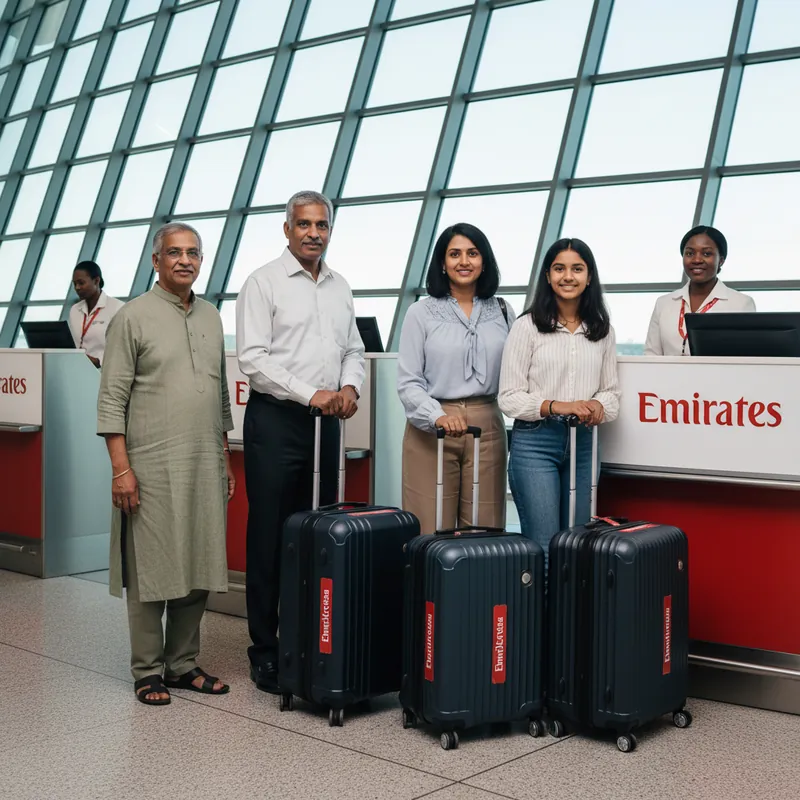
DUR / JNB → BOM 2026: SAA Direct Discontinued — Emirates Dubai vs Qatar Doha for Indian South Africans
The Indian South African community — approximately 1.5 million people across three generations of South African residence — concentrated in KwaZulu-Natal (KZN) Province around Durban and in Johannesburg, represents one of the largest Indian-descent populations outside India. The South Africa-Mumbai travel corridor that serves this community has undergone significant change in 2024-2025: South African Airways discontinued its direct JNB-BOM route as part of the post-restructure network rationalisation, leaving Emirates via Dubai and Qatar Airways via Doha as the two primary routing options. This guide covers the practical implications for Indian-SA travellers heading to Mumbai or onward Indian cities.
TL;DR: SAA JNB-BOM direct discontinued 2024. Indian-SA Mumbai travel 2026 routes via EK Dubai (DXB) or QR Doha (DOH). EK serves JNB, CPT and DUR (DUR-DXB-BOM is meaningful for the Durban-concentrated Indian-SA community); QR serves JNB and CPT only. Economy round-trip $750-1,400 (ZAR 13,800-25,800); business $2,800-5,500. PIO/OCI cards waive Indian visa requirements for eligible Indian-SA travellers. Peak demand: Diwali (Oct-Nov) and December-January diaspora. Booking-window sweet spot: 10-16 weeks ahead saves 25-35% on peak-season fares (source).
In this guide
- The Indian South African community and the SA-India travel corridor
- SAA JNB-BOM direct discontinuation 2024 — what changed
- Emirates via Dubai: the DUR / JNB / CPT options
- Qatar Airways via Doha: JNB and CPT routings
- PIO / OCI cards: visa waiver for eligible Indian-SA travellers
- Family travel patterns and multi-generational considerations
- Three case studies
- Frequently asked questions
The Indian South African community and the SA-India travel corridor {#community}
South Africa’s Indian-descent population traces back primarily to the 1860 onwards indentured labour migrations to the Natal sugar plantations and to subsequent merchant and trader migrations through the late nineteenth and early twentieth centuries. The community has continuously resided in South Africa across multiple generations and is acknowledged as part of South Africa’s foundational demographic composition.
The 2026 population estimate places the Indian-SA community at approximately 1.5 million, concentrated as follows:
| Region | Approximate Indian-SA population | Notable centres |
|---|---|---|
| KwaZulu-Natal Province | ~1,000,000 | Durban, Pietermaritzburg, Tongaat, Verulam, Chatsworth, Phoenix |
| Gauteng Province | ~300,000 | Johannesburg (Lenasia, Laudium, Houghton), Pretoria |
| Western Cape | ~70,000 | Cape Town (Rylands, Athlone) |
| Other | ~130,000 | Distributed across remaining provinces |
The South Africa-India travel corridor serving this community comprises:
- Family-visit travel: Multi-generational visits to maternal / paternal ancestral villages in Gujarat (predominantly), Tamil Nadu, Andhra Pradesh, Karnataka and Maharashtra
- Cultural and religious pilgrimage: Visits to Hindu, Muslim and Christian religious sites; weddings, funerals, family ceremonies
- Business travel: Trade between Indian-SA business networks (textiles, gold, technology, food trading) and Indian partners
- Education travel: Students travelling to Indian universities and vice versa
- General leisure tourism: India tourism for Indian-SA families exploring ancestral regions and broader India
The aggregate annual SA-India passenger volume across all carriers is estimated at approximately 280,000-340,000 in 2026, with Mumbai (BOM) the primary gateway accounting for approximately 60% of total volume and Delhi (DEL), Bangalore (BLR) and Chennai (MAA) splitting the remainder (source).
What changed when SAA discontinued the JNB → BOM direct in 2024? {#saa-discontinued}
South African Airways operated a direct JNB-BOM service for many years pre-2020, providing the only single-airline nonstop option between South Africa and India. The route was suspended during the 2020-2021 pandemic period and the subsequent business rescue, formally reinstated in 2022-2023 on a limited frequency, and then permanently discontinued in 2024 as part of the post-restructure network rationalisation that focused SAA’s mainline operation on a small number of profitable African and select intercontinental corridors.
The structural reasons for the SAA JNB-BOM discontinuation included:
- Yield management challenges: The route had thin margins, competing against high-frequency Gulf-carrier alternatives with substantially lower cost bases
- Fleet allocation priorities: SAA’s reduced widebody fleet (A330-300) was prioritised for the JNB-LHR and JNB-PER corridors with stronger network and corporate-account economics
- Bilateral capacity changes: The India-South Africa bilateral air services agreement allocations were not renewed at the volume needed to support direct viability
The practical consequence for Indian-SA travellers: as of 2024 the South Africa-India journey requires routing via the Gulf carriers (Emirates DXB, Qatar DOH) or via the African hub carriers (Ethiopian ADD, Kenya Airways NBO). The Emirates and Qatar options dominate the market because of frequency, fleet quality and pricing.
Air India operated CPT-MUM direct briefly in 2019 but did not resume the route post-pandemic; Air India serves the African market currently through DEL-NBO and DEL-LOS rather than direct SA service.
How do Emirates via Dubai options compare from DUR, JNB, and CPT? {#emirates-dxb}
Emirates (EK) is the dominant carrier on the South Africa-India corridor in 2026. The carrier serves all three South African gateways (JNB, CPT, DUR) with direct flights to Dubai, then operates 4x daily DXB-BOM service onward.
| South African gateway | EK weekly Africa-DXB | DXB-BOM weekly | Typical economy USD (return) |
|---|---|---|---|
| Johannesburg | 14 (double-daily) | 28 (4x daily) | $780-1,250 |
| Cape Town | 7 (daily) | 28 (4x daily) | $850-1,350 |
| Durban | 4 weekly | 28 (4x daily) | $900-1,400 |
The Durban (DUR-DXB) operation is the structurally important Indian-SA route because Durban is the historic centre of the Indian South African community and the DUR-DXB-BOM combination provides the only single-airline nonstop-segment option for travellers coming from KwaZulu-Natal. The DUR-DXB frequency at 4 weekly is materially lower than JNB-DXB (14 weekly) which produces both higher fares and less schedule flexibility, but the elimination of the JNB connection adds significant convenience for Durban-resident families.
Emirates equipment 2026: JNB-DXB rotations alternate between 777-300ER and A380; CPT-DXB is mostly 777-300ER with some A380; DUR-DXB is 777-300ER. DXB-BOM is 777-300ER on most rotations with A380 on the highest-demand daily frequency.
Emirates strengths for Indian-SA family travel:
- DUR direct connection (no internal DUR-JNB connection)
- 4x daily DXB-BOM provides re-booking flexibility if connections miss
- DXB Terminal 3 has extensive Halal-marked dining, dedicated prayer rooms and family-friendly amenities
- FNB Emirates Skywards Mastercard provides earning depth for South African travellers
Emirates weaknesses for this corridor:
- DUR-DXB frequency limits date flexibility for KZN-based travellers
- Premium economy availability has reduced post-2024 fleet reconfigurations
How does Qatar Airways routing via Doha work from JNB and CPT? {#qatar-doh}
Qatar Airways (QR) serves the South Africa-India corridor via Johannesburg and Cape Town with onward connections to Mumbai via Doha. Qatar does not currently serve Durban directly — DUR-based travellers must position via JNB or CPT to access the QR option.
| South African gateway | QR weekly Africa-DOH | DOH-BOM weekly | Typical economy USD (return) |
|---|---|---|---|
| Johannesburg | 14 (double-daily) | 35 (5x daily) | $760-1,250 |
| Cape Town | 14 (double-daily) | 35 (5x daily) | $830-1,330 |
Qatar equipment 2026: JNB-DOH alternates between 777-300ER and A350-1000 with the A350 increasingly dominant; CPT-DOH primarily A350-1000; DOH-BOM is A350-900 or 787-9 on most rotations.
Qatar Airways strengths for Indian-SA family travel:
- Hamad International Airport (DOH) consistently rated above DXB on ground product (Skytrax World’s Best Airport 2024, 2025)
- A350 long-haul cabin is widely regarded as among the best in commercial aviation
- Al Mourjan Lounge at DOH is family-friendly with dedicated quiet zones
- oneworld alliance integration provides codeshare options with British Airways for triangular SA-DOH-LHR-SA routings
- Qsuite business-class product is the strongest business hard product on this corridor
Qatar weaknesses for this corridor:
- No DUR direct service (KZN travellers must position via JNB or CPT)
- Privilege Club African co-brand cards less extensive than Emirates Skywards
- DOH-BOM connection times can be tighter than EK-DXB-BOM for the demanding traveller
The practical Indian-SA family decision between EK and QR usually reduces to: where do you live, and which loyalty programme do you anchor in? For KZN-resident families EK via DXB wins on the DUR direct convenience. For JNB and CPT-anchored families with no DUR consideration, QR is often preferred for the superior hub experience and A350 cabin.
PIO / OCI cards: visa waiver for eligible Indian-SA travellers {#pio-oci}
For eligible Indian-SA travellers, the Persons of Indian Origin (PIO) and Overseas Citizen of India (OCI) card system materially simplifies India travel. The framework operates as follows:
Eligibility: Persons who themselves, or whose parents, grandparents or great-grandparents were Indian citizens at any time after 1947 (or were eligible to be Indian citizens at the time of Indian independence) are generally eligible for OCI status. Indian-SA families with documented ancestral lineage to India typically meet this threshold across multiple generations.
Rights conferred by OCI:
- Lifelong visa-free entry to India for visits and residence
- No requirement to register with Indian authorities for stays of any duration
- Right to study at Indian educational institutions on equal terms with Indian citizens
- Right to own residential or commercial property in India (with some restrictions on agricultural land)
- Equal treatment for cultural, religious and tourist activities
Rights NOT conferred:
- Right to vote in Indian elections
- Right to hold Indian government employment or constitutional office
- Right to acquire agricultural / plantation land
- Right to a full Indian passport (OCI is supplementary to existing nationality)
PIO history: The PIO card category was merged into OCI in 2015. Existing PIO card holders retain validity; new applications go directly to OCI. The merger simplified the administrative framework without removing benefits.
Application process: OCI applications are processed through the High Commission of India in Pretoria and the Consulate General of India in Durban and Johannesburg. Processing time is typically 3-4 months and requires documentary proof of Indian descent (birth certificates, ancestral property documents, voter registration evidence). Family applications can be submitted together.
For Indian-SA families travelling to India regularly, securing OCI cards for all family members materially reduces administrative friction. The card replaces what would otherwise be a routine visit-visa application process and provides legal certainty for longer or repeated stays.
Family travel patterns and multi-generational considerations {#family-travel}
A characteristic of Indian-SA Mumbai travel that distinguishes it from pure business or pure leisure travel is its multi-generational character. A typical family trip might include grandparents (60s-70s), parents (40s-50s), and children or grandchildren (teens or younger). The travel logistics that matter for this profile include:
Equipment preferences: Wider-body twin-aisle aircraft are materially more comfortable for elderly travellers on the 9-10 hour JNB/DUR-DXB-BOM total flight time. The Emirates A380 and Qatar A350-1000 are objective improvements over the 777 fleet on this dimension.
Layover duration: 2-3 hour layovers at DXB or DOH are typically optimal — long enough for unhurried family connection without exhausting elderly travellers. Both DXB Terminal 3 and DOH Hamad offer family rest areas, prayer rooms, Halal dining, and dedicated stroller / wheelchair services.
Seat selection: For multi-generational families, booking adjacent seats across generations (typically grandparent-grandchild-parent groupings) requires advance seat selection on long-haul. Both EK and QR allow seat selection at booking on most fare classes.
Baggage planning: Multi-generational family travel typically involves gift-giving culture and religious / cultural items — generous baggage allowances matter. Emirates Economy Flex includes 30kg checked; Qatar Economy Classic 30kg. For travellers needing more, Emirates and Qatar both offer pre-purchased excess baggage at reasonable rates.
Meal preferences: Both EK and QR offer multiple Indian meal options pre-bookable through the booking management interface (Asian Vegetarian Meal AVML, Hindu Meal HNML, Jain Meal VJML, Halal Meal MOML). Pre-booking 24-48 hours before departure is essential.
Religious considerations: For Muslim Indian-SA families (the Indian-SA community includes substantial Sunni Hanafi Muslim populations alongside Hindu and Christian communities), prayer-time alignment with flight schedule, qibla direction on aircraft, and prayer-room availability at DXB / DOH are practical considerations. Both carriers and hubs accommodate these well.
Three case studies {#case-studies}
Case 1 — Mr Pravesh Naidoo, 48, Durban-based wholesale-distribution business owner
Pravesh runs a family wholesale-distribution business in Durban serving the KwaZulu-Natal retail trade. He travels to Mumbai 3-4 times annually for supplier meetings (textile and food import) and once annually for a 2-week family trip with his wife, parents and three children. His default routing is DUR-DXB-BOM on Emirates for the DUR direct convenience. He holds Skywards Gold (built through 4-5 annual EK flights) and uses the FNB Emirates Skywards Mastercard for both personal and business spending. OCI cards in place for himself, his wife and children; his parents hold OCI from earlier processing. Annual EK spend approximately $14,000 across mixed business / leisure trips.
Case 2 — Mrs Reshma Patel, 52, Sandton-based accountant
Reshma is part of the Johannesburg-based Indian-SA professional community. Her Mumbai travel is primarily family-visit driven (twice annually) plus occasional business travel for Pan-African client engagements that include Indian connections. She prefers Qatar Airways via Doha for the A350 cabin and Hamad airport experience, and books JNB-DOH-BOM consistently. She holds Privilege Club Platinum (built across both QR-direct flights and Air France-KLM Flying Blue interlining). OCI in place for all family members. Annual QR spend approximately $11,000.
Case 3 — Mr and Mrs Ahmed, 67 and 64, retired Cape Town-based Indian-SA couple
The Ahmeds are retired and travel to Mumbai annually for an extended 6-week family stay (typically October-December timed around family gatherings and the Indian winter). They book economy class with priority for comfort over price and value 2-3 hour layovers over either rushed connections or marathon 8-hour layovers. Their preference is Emirates CPT-DXB-BOM for the equipment and ground product. Both hold OCI cards (Mr Ahmed inherited PIO from the 1990s and converted to OCI in 2015; Mrs Ahmed applied as a spouse). Their annual EK spend is approximately $3,200 for the single family trip.
Frequently asked questions {#faq}
1. Is there a direct flight from Johannesburg or Durban to Mumbai in 2026? There is no direct nonstop flight between Johannesburg (JNB) or Durban (DUR) and Mumbai (BOM) in 2026. South African Airways operated JNB-BOM direct until the route was discontinued in 2024 as part of the SAA post-restructure network rationalisation. All current South Africa to Mumbai travel routes via either Dubai (Emirates), Doha (Qatar Airways), Addis Ababa (Ethiopian Airlines) or Nairobi (Kenya Airways with onward connection). Emirates from JNB and DUR via DXB is the most direct of the available connecting options.
2. Do PIO and OCI card holders need an Indian visa to visit India? Persons of Indian Origin (PIO) and Overseas Citizen of India (OCI) card holders do not require a separate Indian visa to enter India. The OCI card itself functions as a lifelong visa for visits, residence (without voting rights or government employment) and most ordinary travel purposes. The PIO category was merged into OCI in 2015 — existing PIO cards remain valid alongside OCI status. For Indian-South Africans who are eligible (three generations or more of Indian descent), obtaining the OCI card materially simplifies travel between South Africa and India.
3. Emirates vs Qatar Airways from South Africa to Mumbai — which is better? Both Emirates (EK) via Dubai and Qatar Airways (QR) via Doha provide credible South Africa-Mumbai routings in 2026. Emirates has the strongest South African gateway coverage (JNB, CPT and DUR — DUR is meaningful for the Durban-concentrated Indian-SA community); Qatar serves JNB and CPT but not DUR directly. On the DXB-BOM and DOH-BOM onward sectors both carriers operate multiple daily wide-body services. Qatar’s Hamad International Airport (DOH) is generally rated above DXB on ground product; Emirates’ DXB-BOM frequency (4x daily) is the highest of any Gulf carrier.
4. How much does a JNB or DUR to Mumbai return ticket cost in 2026? Round-trip JNB or DUR to BOM economy in 2026 typically ranges from $750 (early-booking, low-season Q1 or Q3) to $1,400 (last-minute, Diwali-peak or December diaspora-return). Business-class round-trip ranges from $2,800 (early-booking, low season) to $5,500 (peak season, last-minute). DUR-DXB-BOM tends to price $50-150 above JNB-DXB-BOM reflecting the lower DUR frequency. Booking 10-16 weeks in advance for peak-season travel (Diwali, December) typically saves 25-35% versus last-minute pricing (source).
5. What is the best layover strategy at DXB or DOH for Indian South African families? For Indian-SA family travel (often multi-generational with grandparents and young children), a layover of 2-3 hours at DXB or DOH is generally optimal — long enough for unhurried connection without exhausting elderly family members or children. Emirates DXB Terminal 3 offers prayer rooms, Halal-marked dining options, family rest areas and dedicated stroller services. Qatar DOH Hamad offers similar amenities with the additional Al Mourjan business lounge for QR business-class passengers being particularly family-friendly. For very long layovers (8+ hours), DXB and DOH both offer airside transit hotels.
Practical guidance for Indian South African Mumbai travel 2026
The 2024 SAA JNB-BOM direct discontinuation is consequential for the Indian-SA community: the only single-flag, single-sector South Africa-India option is no longer available, and Gulf-carrier hub routing is now the universal architecture for this corridor. The practical advice for Indian-SA travellers in 2026:
- For KZN-based families: Emirates DUR-DXB-BOM is the structurally optimal default. The DUR direct convenience outweighs the small fare and frequency premium versus JNB-anchored routings.
- For Gauteng-based families: Either EK or QR via JNB works well. Anchor loyalty in whichever programme has stronger card spending alignment with your banking relationships.
- For Cape Town-based families: Qatar A350 via DOH is generally the marginal preference over EK 777 via DXB for the cabin and hub product.
- For all Indian-SA families: Secure OCI cards for all eligible family members — the administrative friction reduction over a multi-decade travel pattern is substantial.
For broader coverage of African-Gulf-onward routing patterns see our Africa-DXB Emirates hub guide, the Lagos-Beirut Lebanese-Nigerian diaspora travel guide, and the African business travel fare-curve forecast for seasonal pricing planning.
For live fare tracking see our Durban to Dubai flights page and Johannesburg to Mumbai flights page, plus dedicated airline pages for Emirates and Qatar Airways, and airport guides for Durban King Shaka DUR and Mumbai Chhatrapati Shivaji BOM.
Sources
- South African Civil Aviation Authority — Operator Register
- DGCA India — Air Operator Permits
- UAE GCAA — Operator Oversight
- IATA — Africa-India Traffic Reports
- Indian High Commission Pretoria — Visa & Travel Rules
Last verified: 2026-06-22